How to Spot 3-Stage VCP Breakouts in NSE 500 Stocks Before They Run
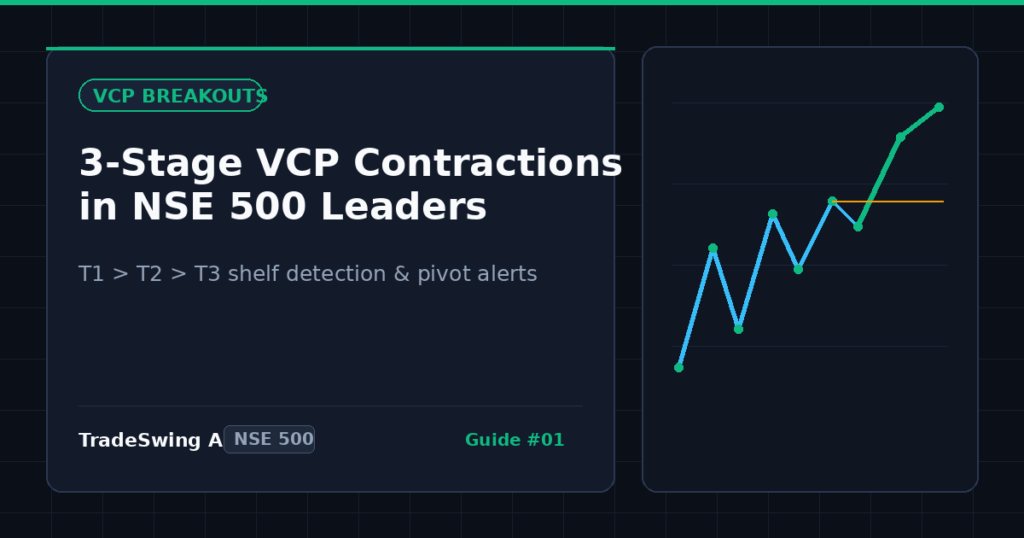
In the Indian equity market, consistent swing trading performance across the NSE 500 universe rarely comes from predicting headlines or staring at 1-minute candlesticks all day. Instead, durable edge comes from repeating a deterministic process focused on Stage-2 NSE 500 leaders contracting across T1 > T2 > T3 shelves. Yet for most active retail traders in India, the gap between knowing what a textbook setup looks like and executing it cleanly with fixed rupee risk remains frustratingly wide.
This guide breaks down the exact mechanics behind 3-stage VCP breakout screener NSE 500 stocks India, why manual workflows break down under real market pressure between 9:15 AM and 3:30 PM IST, and how TradeSwing AI turns this entire workflow into a fast, institutional-grade desktop routine.
Why This Matters for Indian NSE 500 Swing Traders
The National Stock Exchange offers deep liquidity across large-cap, mid-cap, and emerging small-cap leaders, but it also punishes undisciplined entries. Volatility clusters quickly around quarterly earnings, RBI policy days, global macro cues, and sector rotations. When traders rely on fragmented tools—one browser tab for basic screeners, a second tab for TradingView charts, a spreadsheet for share quantity math, and a third tab for broker order entry—execution friction creeps in.
The core bottleneck is almost always 2 to 4 hours scanning 500 charts after market close. Under time pressure, small mistakes compound: entering a stock with an unrounded trigger price, overlooking a 45-day regulatory red flag, sizing a volatile 9% stop-loss the same as a tight 3% base, or adding a fourth correlated stock in the same sector right before a pullback.
The Real-World Problem With Manual Workflows
Consider what happens on a typical weekday evening in India. After the 3:30 PM IST close and final NSE bhavcopy settlement, a trader sits down to review the market. Without structured automation, three problems immediately surface:
- Signal-to-Noise Fatigue: Manually flipping through hundreds of NSE 500 charts causes decision fatigue. By chart number 120, loose, wide, and low-liquidity bases start looking acceptable simply because you want to find a trade for tomorrow.
- Inconsistent Risk Math: Computing exact 1R share quantities across changing stop-loss distances—while respecting maximum single-stock allocation caps and NSE’s ₹0.01 (<₹250) versus ₹0.05 (≥₹250) tick increments—invites arithmetic errors.
- Blind Spots Around News & Market Breadth: A chart can look textbook on price alone while hiding an active SEBI notice, promoter stake sale, or deteriorating NSE 500 breadth beneath the surface.
How TradeSwing AI Solves It Step by Step
TradeSwing AI was engineered specifically for Indian equity swing traders to replace guesswork and fragmented spreadsheets with automated 3-stage VCP detection with tick-rounded Buy Trigger and Stop-Loss. Everything runs 100% locally on your macOS or Windows desktop, keeping your trade journal, watchlists, and personal broker API credentials private on your own machine.
1. Market Regime & Breadth Context First
Before evaluating any individual stock, TradeSwing AI checks NIFTY 50 & Regime alongside live NSE 500 Market Breadth (% of stocks above 50 EMA and 200 SMA). When breadth weakens below 45%, the app can automatically halve your 1R risk per trade—protecting your equity curve during choppy corrections instead of forcing full-size breakouts into headwinds.
2. Proprietary AI Ranking & 45-Day Catalyst Verification
Rather than dumping an unsorted list of tickers, TradeSwing AI scores each candidate with an objective Quality Score and calibrated AI Win %. Clicking any row opens the Interactive Chart Inspector alongside the 45-Day AI Catalyst & Red-Flag Scanner, giving you immediate visibility into earnings, order wins, promoter activity, and regulatory alerts before a single rupee is committed.
3. Tick-Accurate 1R Sizing & Broker Order Ticket
Every setup displays exact Buy Trigger (₹), Stop-Loss (₹), 1R Qty, Allocated Capital (₹), and +2R Target (₹)—already rounded to valid NSE ticks. You can inspect the pre-built Broker Order Ticket, export a ready-to-upload basket, or execute directly using your own local BYOK broker credentials for Zerodha Kite, Dhan, AngelOne, Upstox, Groww, Fyers, or ICICI Direct.
4. Closed-Loop Tracking in the Local SQLite Trade Journal
Once you log a setup, TradeSwing AI tracks it through every stage: Waiting Trigger → Active Open → +2R Free Ride (SL @ Entry) → Closed. Your live Open Risk (5R Heat), 30% Sector Exposure Guard, unrealized/realized P&L in ₹ and R, and cumulative R-curve update automatically—eliminating manual spreadsheet maintenance forever.
Practical Implementation Checklist for Your Next Session
- Sync EOD Universe After Close: Run Refresh EOD Universe after 4:00 PM IST to pull clean daily NSE 500 data and market breadth metrics.
- Verify Regime & Risk Budget: Confirm your Portfolio Capital (₹), Max 1R Risk (0.5%–1.0%), and remaining 5R Open Heat capacity in the sidebar.
- Filter by Quality & Catalyst: Focus on top-ranked setups (Quality Score ≥ 70) with clean 45-day catalyst profiles and clear 30% sector headroom.
- Stage Tick-Valid Orders: Use the exact Trigger, Stop-Loss, and 1R Qty from the Broker Order Ticket—or connect live 90-second 15m ORB / VWAP validation during market hours.
- Enforce the +2R Free Ride Rule: Log every fill in the Trade Journal and move your stop-loss to entry once a winner reaches +2R.
Frequently Asked Questions
What is a 3-stage VCP breakout in NSE 500 stocks?
A 3-stage Volatility Contraction Pattern (VCP) occurs when an NSE 500 stock in a Stage-2 uptrend pulls back across three progressively narrower price swings (T1 > T2 > T3) while volume dries up near its 52-week high, signaling institutional supply absorption prior to a breakout.
Why do loose VCP bases fail more often on Indian equities?
Loose bases with wide 15–25% final shelves lack institutional sponsorship and leave overhead supply intact, causing breakouts to reverse sharply during morning NSE volatility.
How does TradeSwing AI detect VCP contractions automatically?
TradeSwing AI’s EOD scanner evaluates Stage-2 moving average alignment, measures T1 > T2 > T3 shelf depth, verifies volume dry-up, and scores each setup with an AI Win %.
What minimum daily turnover should Indian swing traders use for VCP scans?
A minimum average daily turnover of ₹5 Cr (₹50 million) ensures sufficient liquidity on NSE so your Buy Trigger and Stop-Loss orders fill without excessive slippage.
Does TradeSwing AI calculate exact NSE trigger prices for VCP setups?
Yes. Every VCP candidate includes an exact pivot Buy Trigger, structural Stop-Loss, and +2R target automatically rounded to ₹0.01 (<₹250) or ₹0.05 (≥₹250) NSE ticks.